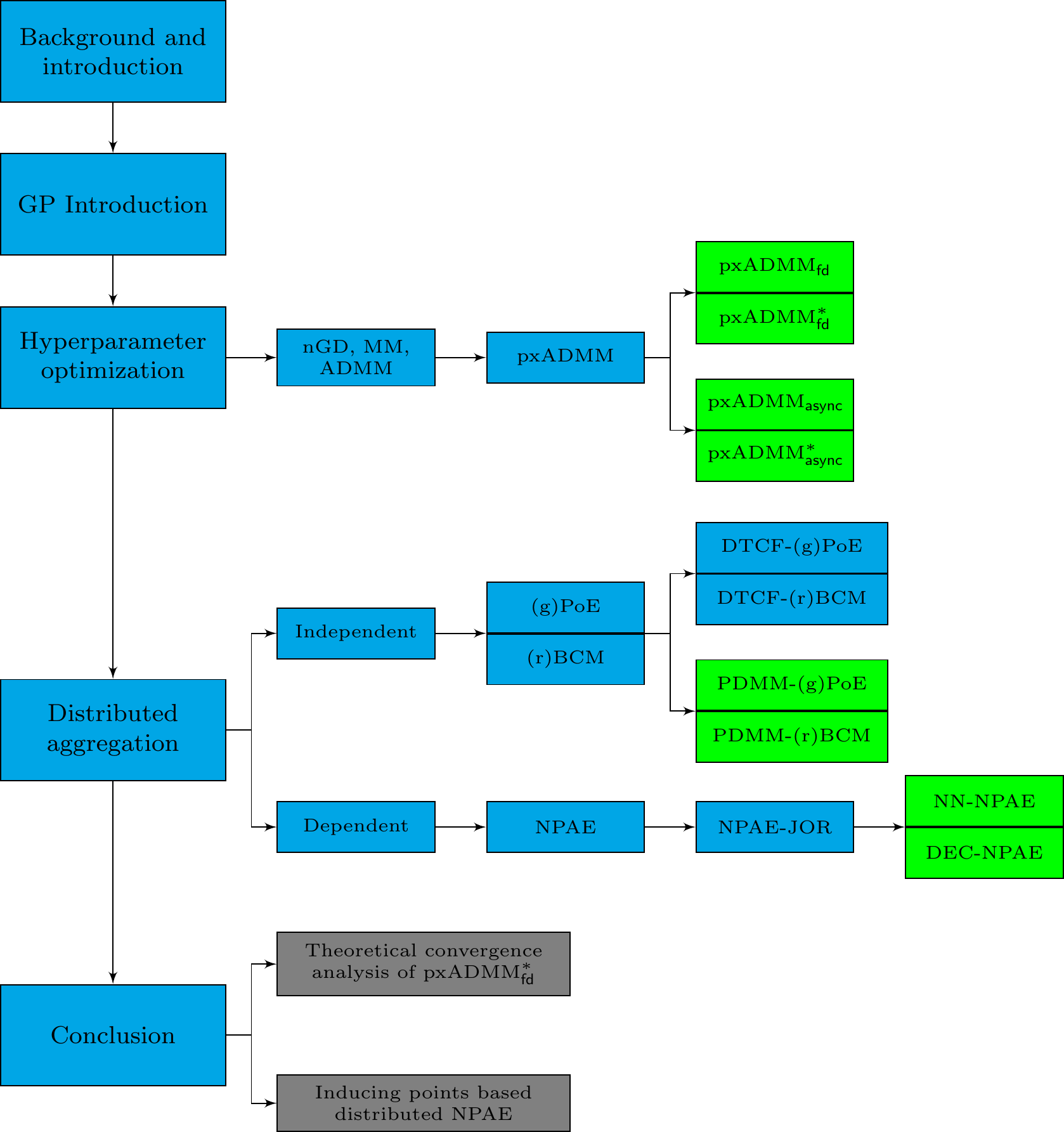
This project is the research code behind my MSc thesis, Distributed Gaussian Process for Multi-agent Systems, and the resulting ICASSP 2023 paper. It asks how a network of agents can jointly fit a Gaussian process (GP) to a spatial field, such as sea-surface temperature, when no central station is available to coordinate them.
The problem
A Gaussian process learns a spatial field from scattered observations, but its hyperparameters (length scale, noise, and signal variance) must be tuned globally. In a multi-agent system each agent only sees part of the field, so the standard solution, proximal alternating direction method of multipliers (pxADMM), still relies on a fusion center. That center is both a scalability bottleneck and a single point of failure.
Fully-distributed hyperparameter optimization
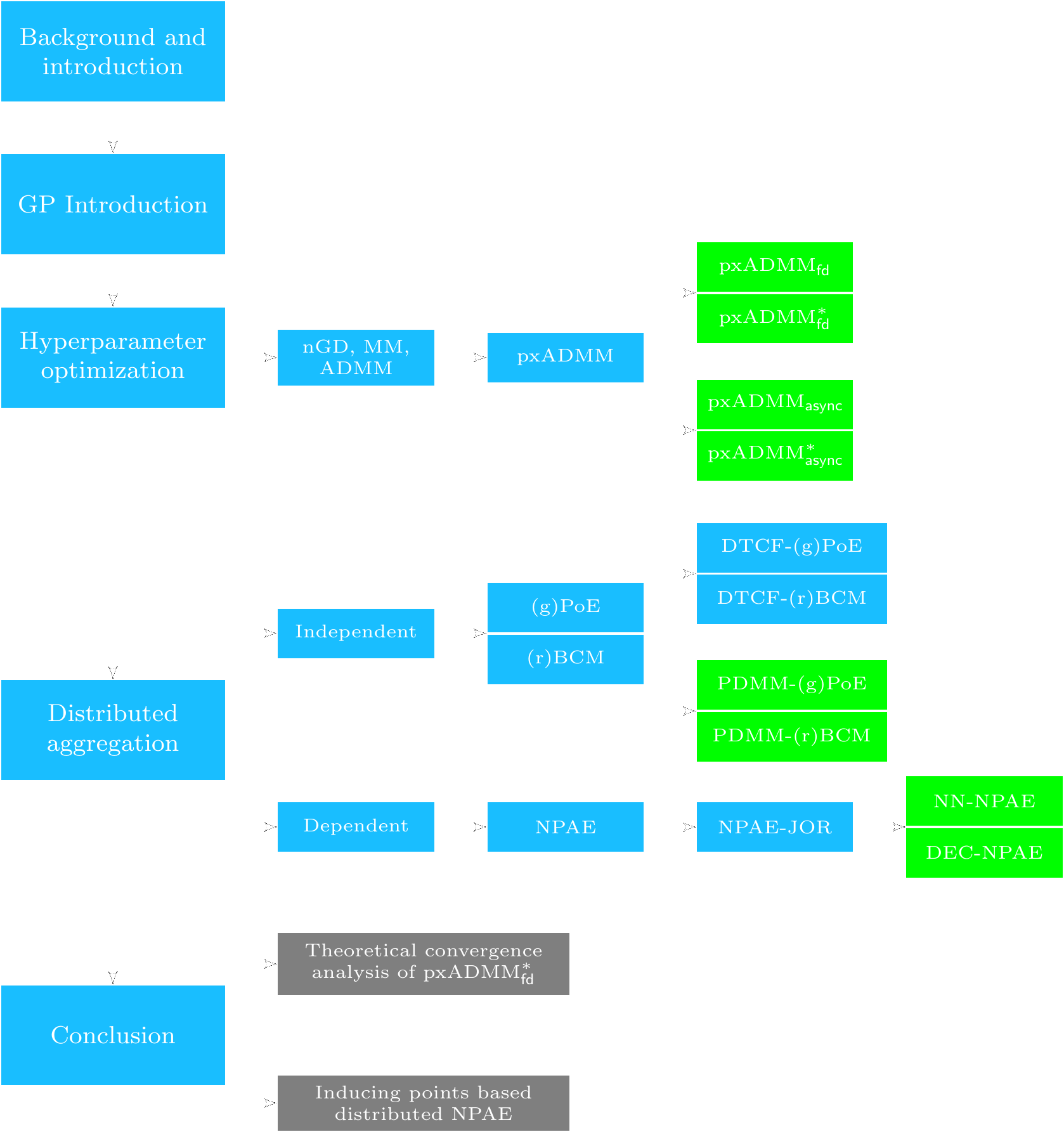
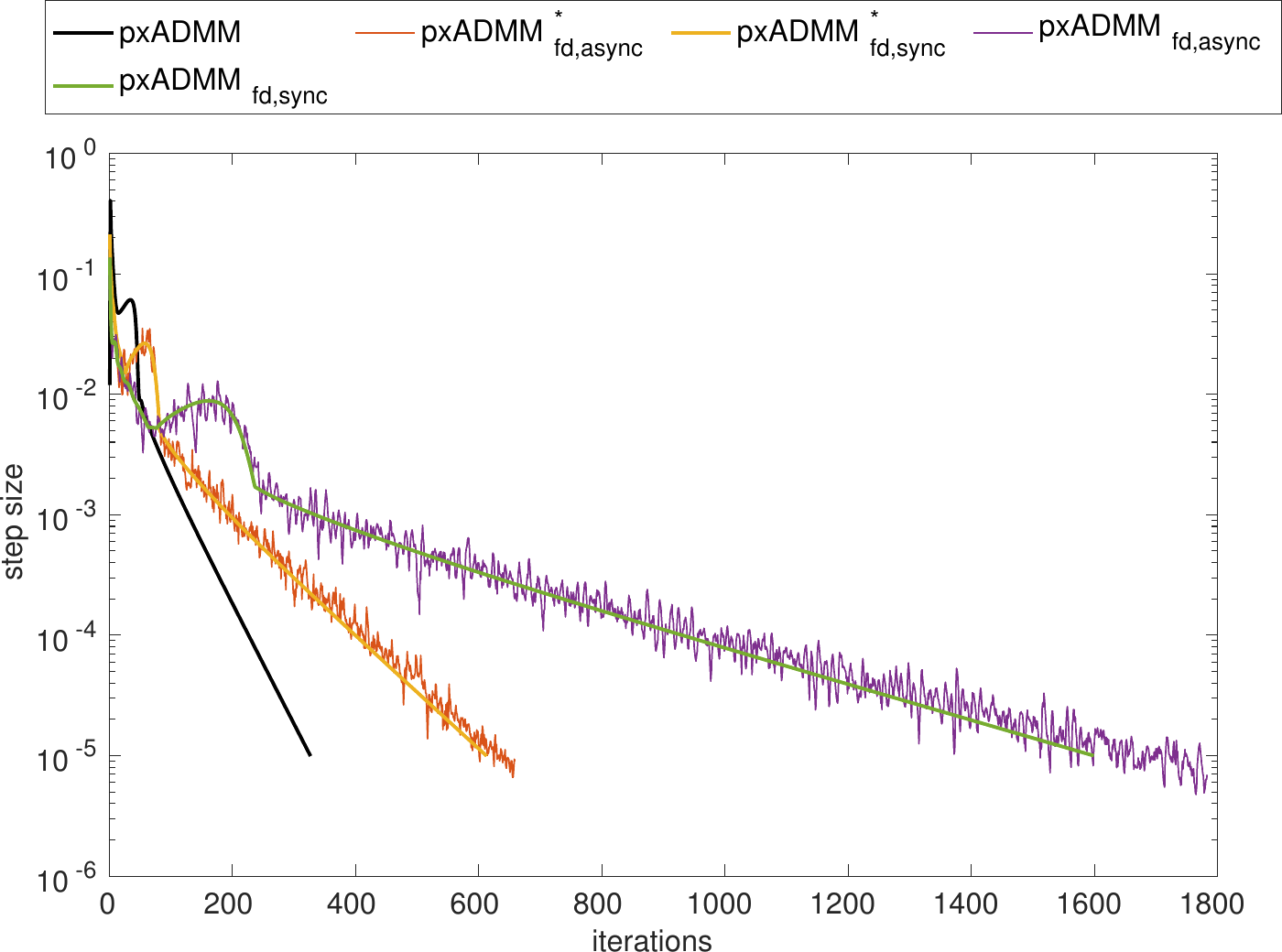
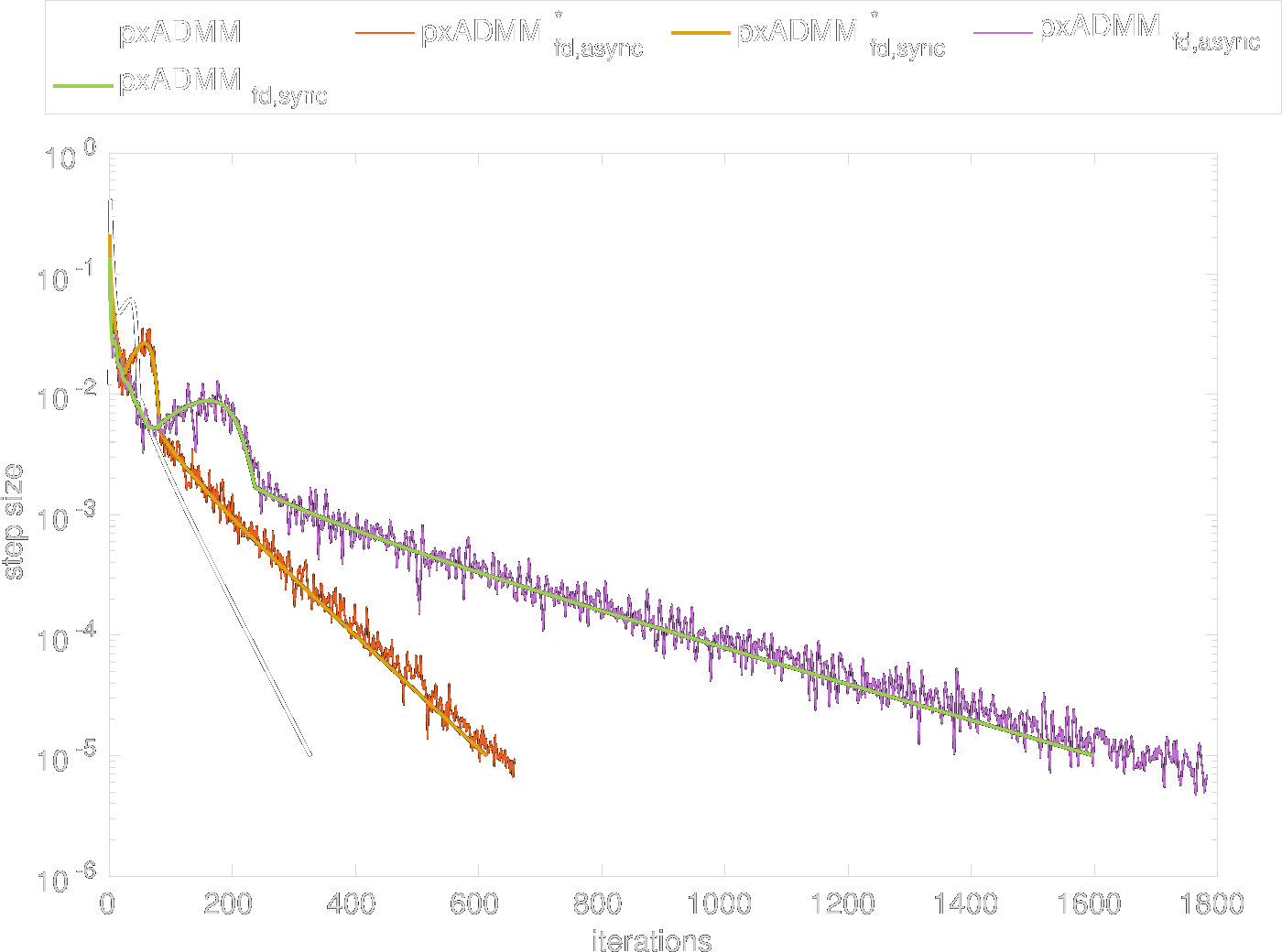
Building on pxADMM, this work develops two fully-distributed variants that remove the central station entirely. It also introduces asynchronous updates so that agents with heterogeneous processing times still reach a stable solution. Simulations on synthetic fields and real GHRSST sea-surface-temperature data confirm stable convergence.
Aggregating agent predictions
Once the local GPs are tuned, their predictions have to be combined into one field estimate. The code covers two regimes:
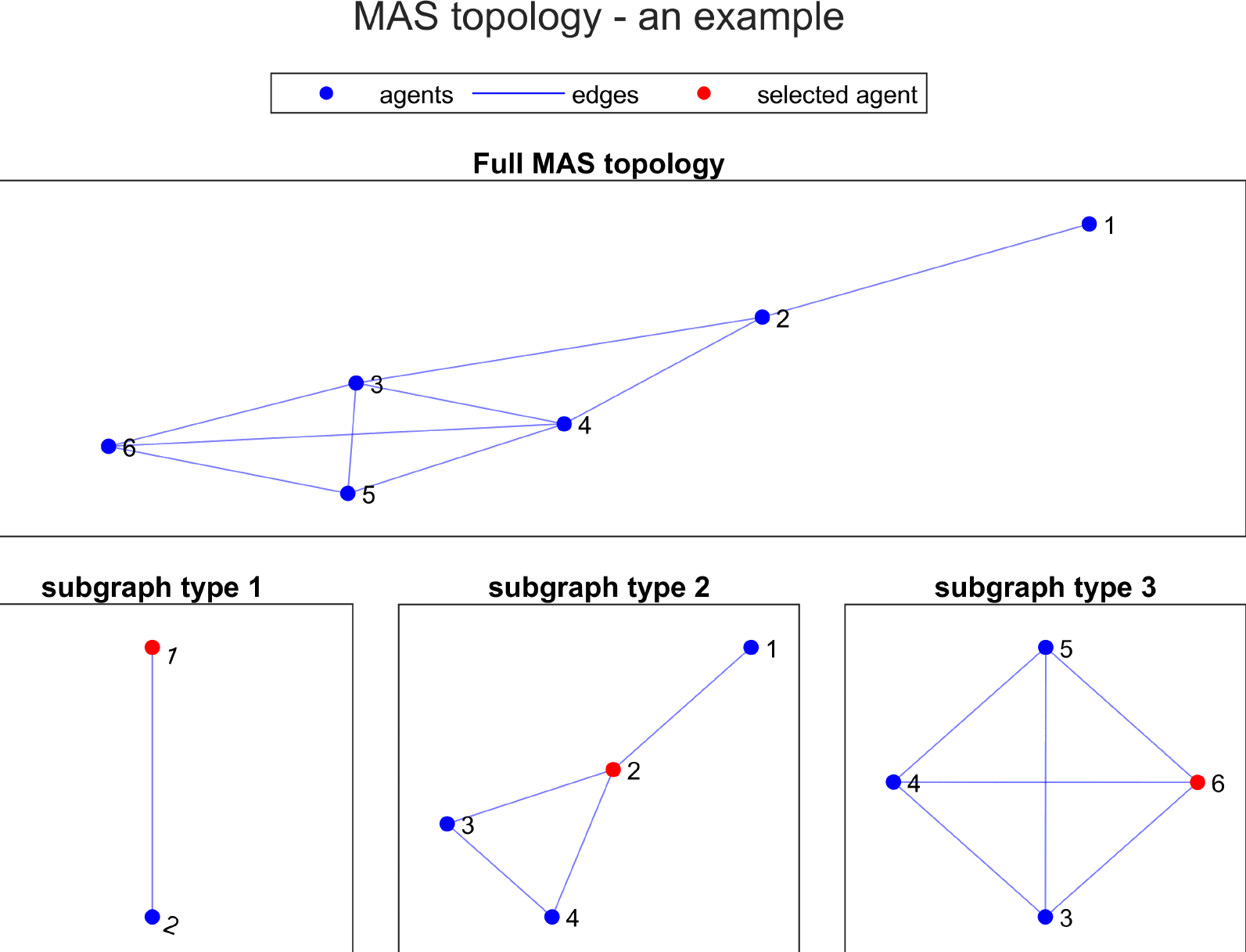
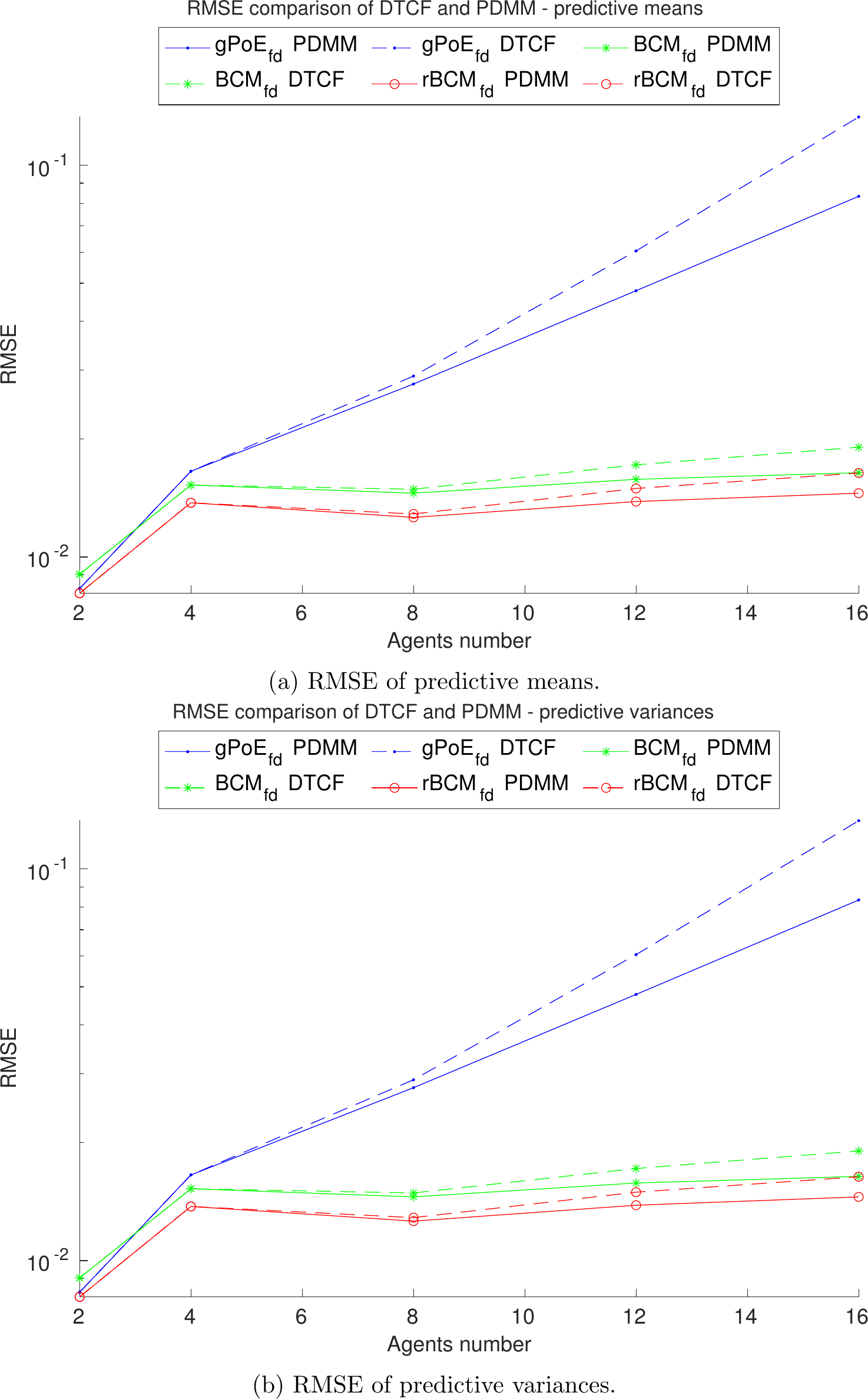
- Independent local datasets. The product-of-experts (PoE) and Bayesian committee machine (BCM) families can be distributed with a discrete-time consensus filter. This work proposes a primal-dual method of multipliers (PDMM) that reaches the same aggregation in fewer iterations.
- Correlated local datasets. Nested pointwise aggregation of experts (NPAE) accounts for cross-correlation between agents, but its NPAE-JOR variant needs a flooding step on a complete graph. CON-NPAE extends it to a fully-distributed algorithm on connected graphs and outperforms independence-based methods in highly connected networks.
Outcomes
- Peer-reviewed paper: P. Zhai and R. T. Rajan, Distributed Gaussian Process Hyperparameter Optimization for Multi-Agent Systems, ICASSP 2023.
- MSc thesis: Distributed Gaussian Process for Multi-agent Systems, TU Delft, 2022, available in the TU Delft repository.
- Open MATLAB implementation of all algorithms, released on GitHub.